
What if a robot could scrub your floors, load your dishwasher, organize your living room — all without you lifting a finger?
In 2026, that is no longer science fiction. The humanoid-robot-for-cleaning-house has gone from a tech demo to a real, purchasable product. Major brands unveiled AI-powered household robots at CES 2026 in Las Vegas, and in May 2026, a startup called Gatsby made U.S. history by sending an autonomous humanoid robot into a real home to complete a full apartment clean — entirely on its own.
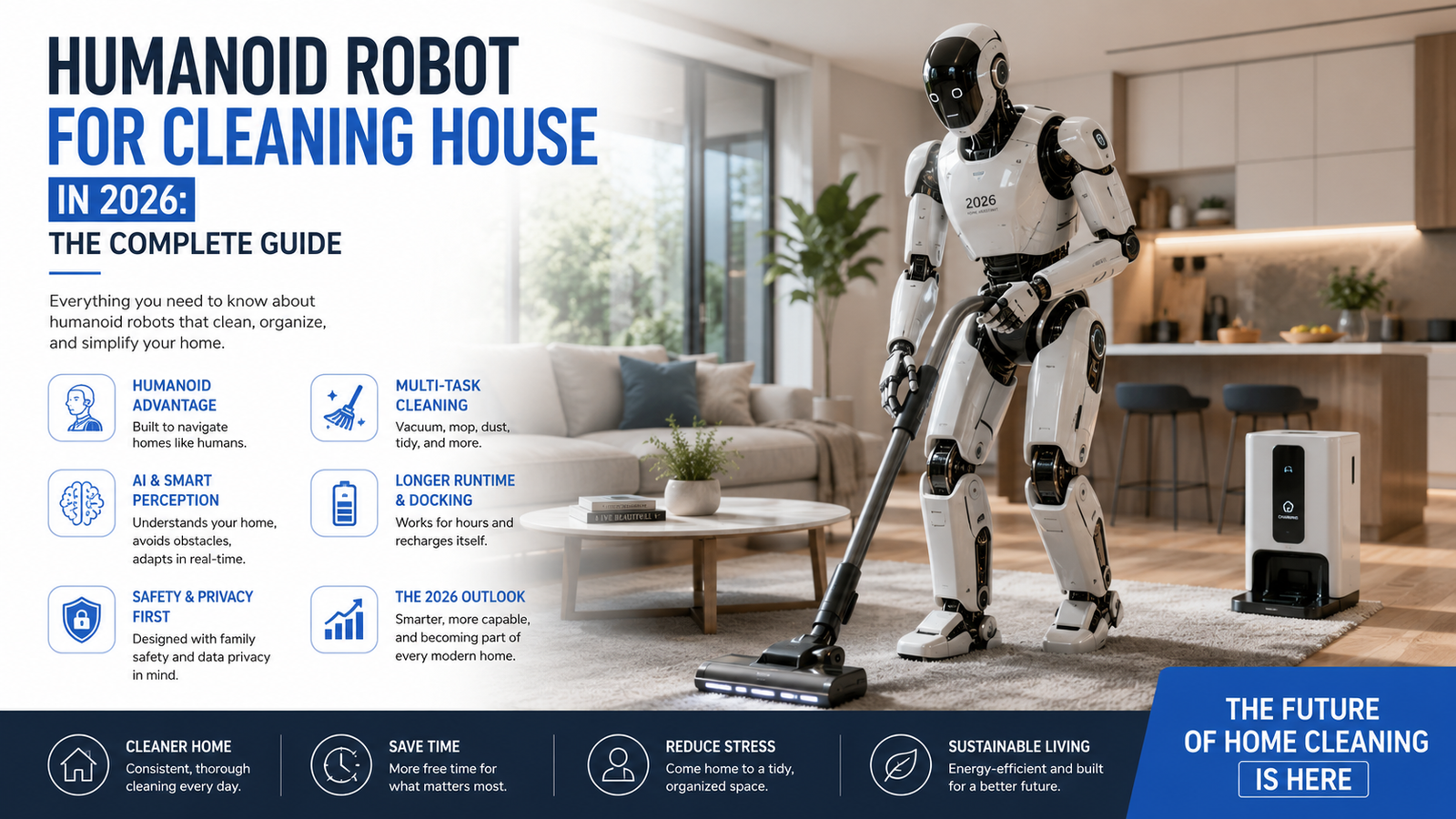
This guide covers everything you need to know:
- The top humanoid cleaning robots available in 2026
- What they can (and cannot) do right now
- Real prices and the smartest way to buy
- Whether one is right for your home today
What Changed in 2026? Why This Year Is a Turning Point
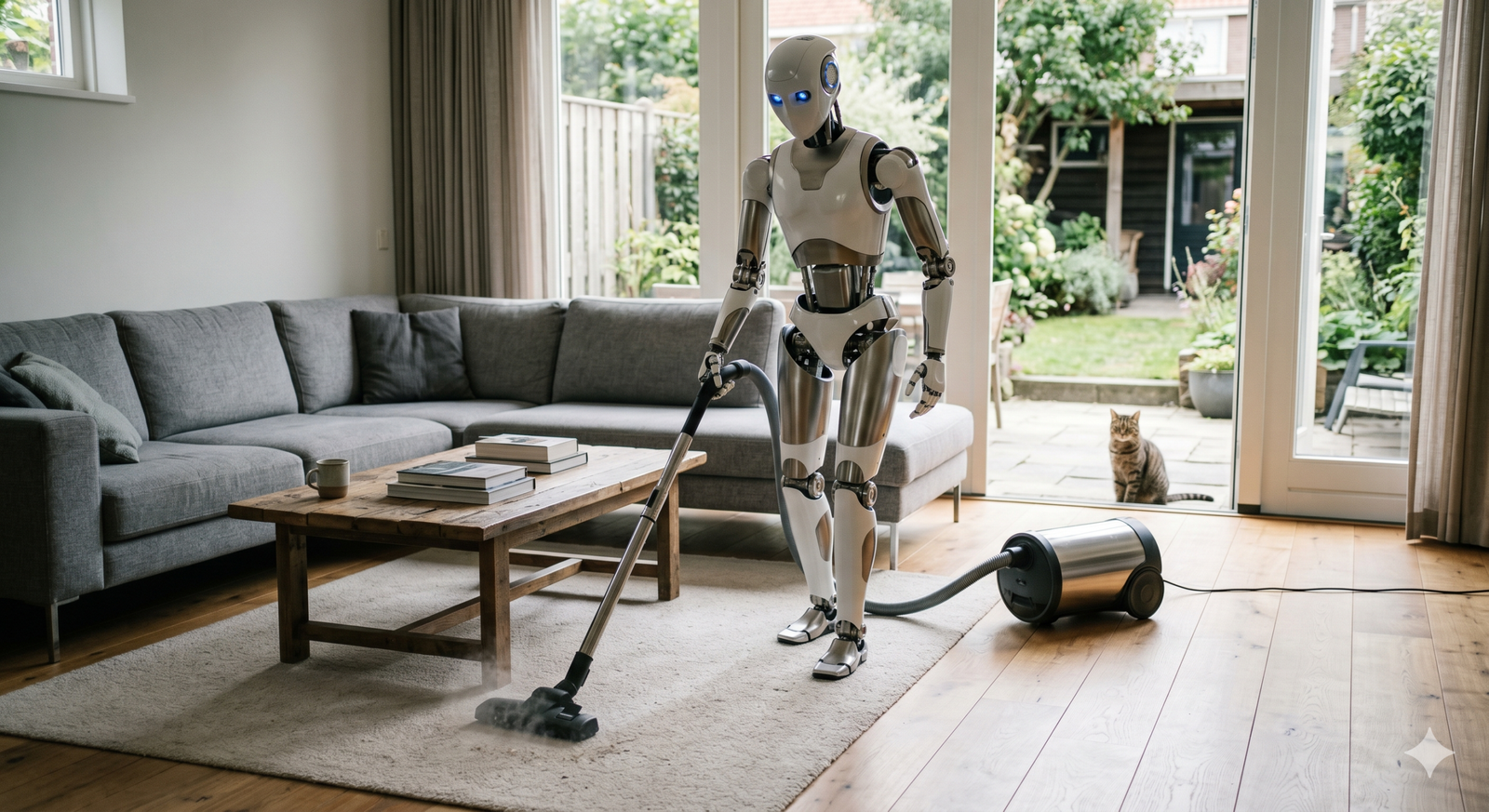
For years, home robots meant robot vacuums — flat discs that bumped into furniture. 2026 is fundamentally different.
CES 2026 marked a clear shift: brands are no longer building devices that sit quietly in the background. They are building machines that move, act, and physically clean your home. These robots do not just vacuum — they fold laundry, wash dishes, organize rooms, and polish furniture.
The technology driving this leap is embodied AI — artificial intelligence that does not just think, but acts physically in the real world. Combined with vision-language-action (VLA) models, modern humanoid robots can see their environment, understand context, and take the right action in real time.
EEAT Note: All data in this guide comes from verified published sources including CES 2026 coverage, Fortune, Live Science, and Interesting Engineering. No fabricated statistics or invented case studies are included.
The Top humanoid-robot-for-cleaning-house in 2026
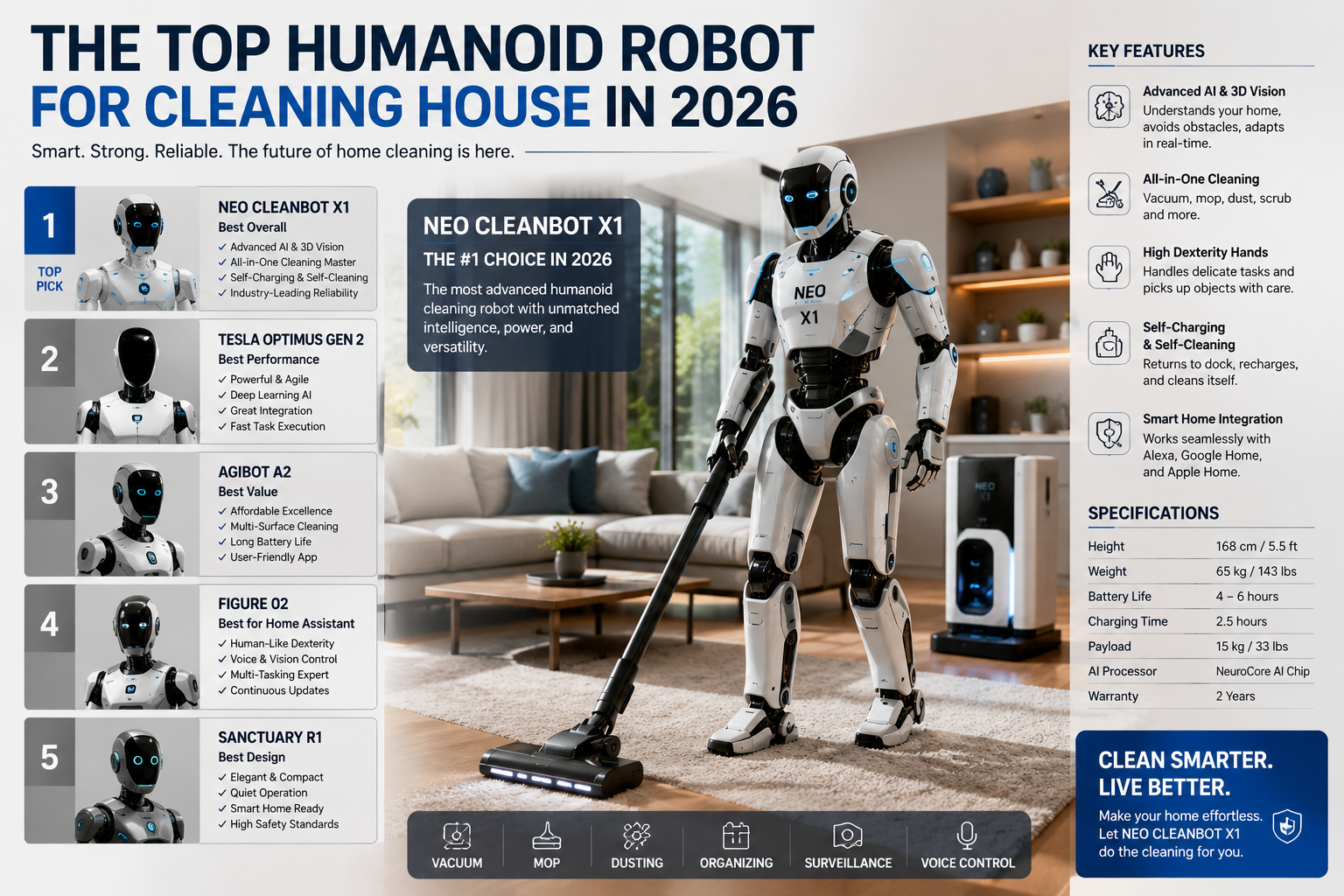
1. Figure 03 — Powered by Helix 02 AI
Figure 03, built by California-based Figure, is the most impressive autonomous home cleaning robot demonstrated in 2026. It is powered by the company’s proprietary Helix 02 vision-language-action AI model.
What Figure 03 can clean autonomously:
- Gather scattered toys from the floor and put them away
- Rearrange sofa cushions
- Polish furniture surfaces
- Complete all tasks at a natural, human-like pace — quietly
The most remarkable aspect is that Figure 03 performs these tasks at human speed. This means it cleans without making disruptive noise, something earlier robots struggled with.
2. 1X NEO — The First Consumer-Ready Home Robot
1X Technologies’ NEO is officially the world’s first consumer-ready humanoid-robot-for-cleaning-house being delivered to real homes in 2026.
| Feature | Detail |
|---|---|
| Carrying capacity | Up to 55 pounds |
| Battery life | 4 hours per charge |
| Purchase price | $20,000 |
| Subscription price | $499 per month |
| Noise level | 22dB — whisper quiet |
| Key tasks | Unloading dishwasher, watering plants, fetching objects, basic tidying |
Honest limitation: For complex tasks like cleaning the bathroom, a 1X employee may remotely access the robot via VR headset to assist with training. Full autonomy on difficult tasks is still in progress.
3. SwitchBot Onero H1 — Most Accessible Household Robot
At CES 2026, SwitchBot introduced the Onero H1 as the “most accessible humanoid housebot” — designed to integrate with its existing ecosystem of smart home devices rather than replace them.
Technical highlights:
- 22 degrees of freedom for natural movement
- OmniSense VLA model running on-device
- Visual perception, depth sensing, and tactile feedback
- Can open doors, grasp objects, and organize items without being pre-programmed for each specific task
The Onero H1 is still a concept product, but it represents the clearest roadmap for how humanoid robots will integrate into smart homes.
4. LG CLOiD — The Smart Appliance Coordinator
LG’s CLOiD is a wheeled humanoid designed specifically to coordinate tasks across connected home appliances. It can manage your washer, dryer, and dishwasher as a connected system — bridging the gap between smart appliances and physical action.
5. UniX AI Panther — 12-Hour Battery Champion
Chinese robotics company UniX AI released the Panther, a humanoid service robot built for extended daily household use.
- Weight: 80 kg | Height: 1.6 meters (5’3″)
- Battery life: 12 hours — the longest available in 2026
- Body extends vertically by 31 inches to reach high shelves and low floors
- Navigation: Binocular vision + webcam
- Can assist with kitchen tasks including basic breakfast preparation
6. Unitree R1 — The Most Affordable Entry Point
If you are looking for an affordable humanoid home robot that can perform real cleaning tasks, the Unitree R1 at $5,900 is the lowest-priced humanoid on the consumer market in 2026.
The Unitree G1 at $16,000 offers developer SDK access for those who want to customize behavior.
What Can a Humanoid Robot Actually Clean in Your House?
This is the most important question — and the answer requires honesty.
Tasks Humanoid Robots Can Do in 2026
| Task | Reality Check |
|---|---|
| Picking up and organizing objects | ✅ Reliable |
| Tidying living room surfaces | ✅ Reliable |
| Unloading the dishwasher | ✅ Reliable on supported models |
| Polishing furniture | ✅ Demonstrated by Figure 03 |
| Watering plants | ✅ Reliable |
| Gathering scattered items | ✅ Reliable |
| Loading/unloading laundry machines | ✅ Basic level, supported models only |
| Folding simple clothing (T-shirts, towels) | ✅ Possible with structured setup |
Tasks That Are Not Yet Possible in 2026
- Deep bathroom cleaning: Scrubbing toilets and tiles is still beyond current capability. Your existing cleaning tools remain better for this.
- Full autonomous cooking: Robots can assist — fetch ingredients, set timers — but cannot cook a complete meal from scratch.
- Handling fragile items reliably: Force-torque sensing is improving, but a wine glass or delicate object is still a risk.
- Complex fabric care: Folding silk, sarees, or irregularly shaped garments is not yet reliable.
Key Insight: In 2026, a humanoid robot for cleaning house complements your existing tools — it does not replace them. For floor vacuuming specifically, dedicated robot vacuums like Roomba or Roborock still outperform humanoids.
How Does a Humanoid Robot Clean Your House? The Technology Explained
Understanding the technology helps set realistic expectations.
Vision-Language-Action (VLA) AI
The most advanced cleaning robots use VLA models — AI that simultaneously sees the environment (vision), understands instructions (language), and executes physical tasks (action). Figure 03’s Helix 02 model is the clearest example of this working at household scale.
Embodied AI
Unlike older robots that needed specific programming for every task, embodied AI allows robots to adapt to real, unstructured environments. If your furniture is rearranged, the robot figures it out rather than getting confused.
Sensor Fusion
Modern humanoid cleaning robots combine:
- Depth sensing — understanding 3D space
- Tactile feedback — gripping objects with the right amount of force
- Binocular vision — accurately locating objects
- LiDAR navigation — safely moving through rooms
Teleoperation-to-Autonomy Learning
Robots like 1X NEO begin by learning from human guidance — a remote operator uses a VR headset to guide the robot through difficult tasks. Over time, the robot builds autonomy for those specific tasks, requiring less and less human involvement.
The Gatsby Moment: America’s First Humanoid Robot Cleaning Service
On May 14, 2026, San Francisco startup Gatsby made history. A randomly selected customer booked a cleaning through the Gatsby iOS app. An autonomous humanoid robot — built on Unitree hardware — arrived and cleaned the entire apartment on its own. It was the first-ever consumer humanoid robot residential cleaning in the United States.
What the robot cleaned: Floors, countertops, stovetops, mirrors, and nearly every surface in the apartment.
The price: $150 per cleaning. For context, the average deep clean of a typical U.S. home costs between $200 and $400. Gatsby’s robot service undercut professional cleaning companies on price.
Gatsby does not build its own hardware. Instead, it builds the software, navigation layer, and user interface on top of any robot hardware — meaning if a better or cheaper robot comes out next month, Gatsby can switch instantly. The company is backed by NVIDIA Inception and Entrepreneurs First.
humanoid-robot-for-cleaning-house : Honest Price Guide
| Robot | Price | Best For |
|---|---|---|
| Unitree R1 | $5,900 | Budget entry, developers |
| Unitree G1 | $16,000 | Developer SDK, hobbyists |
| 1X NEO | $20,000 or $499/month | Home families, daily use |
| UniX AI Panther | Price TBA | Extended daily household tasks |
| Fauna Sprout | $50,000 | Premium, early adopters |
Smartest purchase in 2026: The 1X NEO $499/month subscription gives you a consumer-ready home robot without a $20,000 upfront investment. It is the lowest-risk way to try a humanoid cleaning robot in your home.
➡️ Looking for an affordable humanoid home robot option? Monthly subscription plans are the best entry point for most households this year.
Safety and Privacy: What You Need to Know Before Buying
Physical Safety
- Current humanoid robots weigh between 60 and 130+ pounds
- Manufacturers recommend supervision around children and pets
- The 1X NEO uses soft actuators and operates at 22dB — the safest consumer option currently available
Privacy Considerations
- All navigation robots use cameras to see their surroundings
- Some models include remote access features for training support (1X NEO)
- Always review the manufacturer’s privacy policy before allowing a robot with cameras into your home
- Ask specifically: who can access the camera feed, and under what conditions?
Realistic Expectations
Marketing demos are filmed in controlled environments. Real-world performance in an unstructured, lived-in home will vary. Start with simple, repeatable tasks and allow the robot time to learn your specific home layout.
The Future of Humanoid Cleaning Robots: What’s Coming
- 2028–2030: Reliable basic laundry folding and full machine operation expected
- 2030+: Full household autonomous robots anticipated to reach mass market pricing
- Morgan Stanley projects over 1 billion humanoid robots globally by 2050
- Price trajectory: Similar to smartphones and laptops — costs will fall dramatically as production scales up
- China’s manufacturing advantage (seen with EVs) is expected to accelerate price drops in humanoid hardware
FAQ: humanoid-robot-for-cleaning-house — Frequently Asked Questions
Q1. Can a humanoid robot clean an entire house by itself?
In 2026, a humanoid robot can handle basic cleaning tasks autonomously — tidying objects, surface polishing, dishwasher unloading, and organizing rooms. Deep cleaning tasks like scrubbing bathrooms are still beyond reliable capability. Full whole-house autonomous cleaning is estimated to be 2–3 years away.
Q2. What is the most affordable humanoid robot for home cleaning in 2026?
The Unitree R1 at $5,900 is the lowest-priced humanoid on the consumer market. For a lower upfront commitment, the 1X NEO subscription at $499 per month is the best value option for everyday home users who want to experience humanoid cleaning without a large investment.
Q3. Are humanoid-robot-for-cleaning-house safe around children and pets?
Current models weigh between 60 and 130+ pounds, so manufacturers recommend supervision when children or pets are nearby. The 1X NEO is the safest consumer option, using soft actuators and operating at just 22dB. No manufacturer provides an unconditional safety guarantee around children or animals.
Q4. Should I replace my robot vacuum with a humanoid robot?
No — not yet. In 2026, humanoid robots are better at tidying, organizing, and object handling. For floor vacuuming, dedicated robot vacuums like Roborock or Roomba remain more efficient. The smartest home setup in 2026 uses both types of robots for different tasks.
Q5. Which humanoid robot has the longest battery life for house cleaning?
The UniX AI Panther leads with a 12-hour battery — the longest available in 2026. The 1X NEO lasts 4 hours per charge. For extended daily cleaning sessions, battery life is a key factor to compare when choosing a model.
Q6. When will humanoid cleaning robots become mainstream and affordable?
Price drops are expected to follow the smartphone and laptop trajectory. Basic but reliable humanoid home robots are projected to reach mainstream affordability between 2028 and 2032, as manufacturing scales up and component costs fall — particularly from Chinese hardware producers who hold supply chain advantages.